

The Arpoador Rock
“They asked me to define the Arpoador. It is a place within Guanabara, but not part of the outside world, where we rarely go and where we would, perhaps, like to live.”
In his 1960s chronicle “Contemplação do Arpoador”, the poet Carlos Drummond de Andrade captured—as only he could—the visual poetry of the Arpoador. Although born in Minas Gerais, Drummond spent most of his life in Rio de Janeiro, strolling around and admiring the beauty of the region; fittingly, his statue stands in nearby Copacabana.
Indeed, Pedra do Arpoador (Arpoador Rock) is one of the places where Rio’s beauty is most visible. In 1989 it was listed as a protected heritage area “for its scenic, environmental, and ecological significance.”
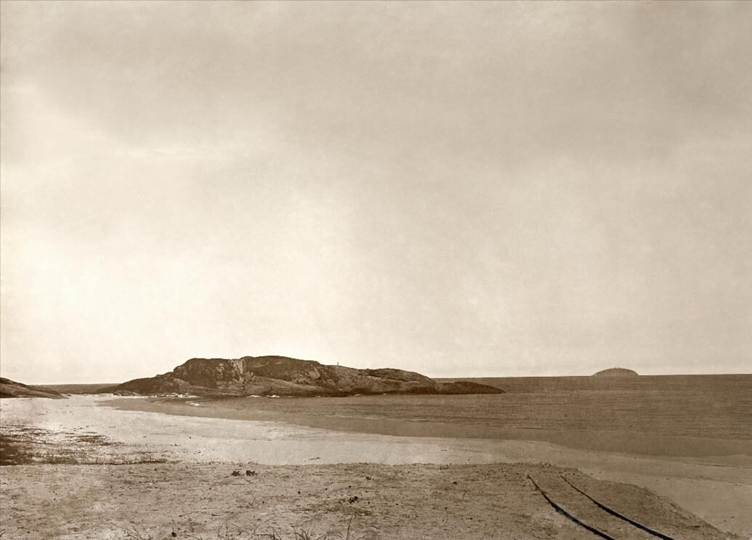
Pedra do Arpoador and tram tracks, seen from the vicinity of the Barreira Vianna family residence, in Ipanema, at the corner of Vieira Souto Avenue and Francisco Otaviano Street. José Baptista Barreira Vianna, 1902. IMS Collection.
Before the 20th century, the area was uninhabited. It appears on a French map from 1751 as “Ponta de Arpoador”. The name derives from the practice of whale hunting. The rocks were used by harpooners (arpoadores) as a lookout point to spot whales approaching the coast.
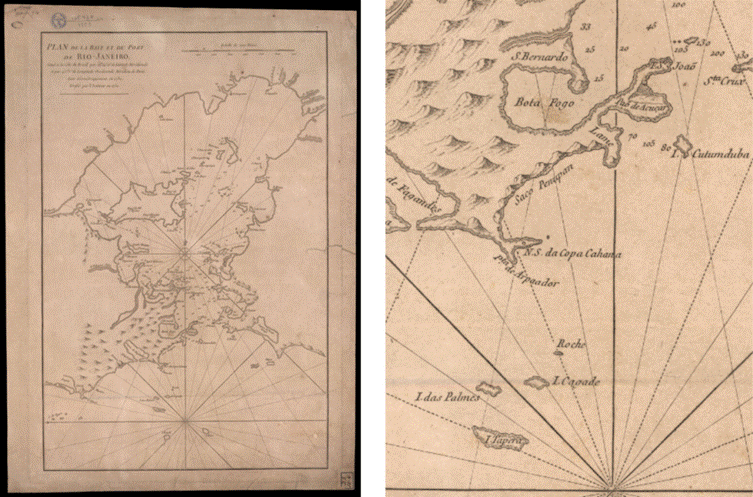
Plan de la Baye et du Port de Rio-Janeiro, 1751. National Library Foundation
Along with the urban transformations of the 20th century came tunnels and other access roads, and the neighborhood of Ipanema became more popular. Many foreigners took up residence in the area, giving it a cosmopolitan feel.
Ipanema grew in importance on the city’s cultural scene, and the Arpoador stood out as an emblematic place in the formation of the carioca lifestyle. After all, it was there that surfing and the bikini were born—two true carioca ‘institutions’. The most widely circulated version of the story holds that the bikini made its first appearance on Arpoador Beach in 1948—just two years after it was invented by the Frenchman Louis Réard in 1946. The pioneer was a German woman, Miriam Etz, who is said to have made her own bikini. Many people found the new swimwear far too risqué, but almost anything was allowed on Arpoador Beach, and the fashion spread from there to other beaches in the city.
The Arpoador was also the principal birthplace of surfing in Brazil, which began to gain popularity in the late 1950s. Figures such as Arduíno Colassanti, Irencyr Beltrão, Paulo Preguiça and Jorge Paulo Lemann turned it into a meeting point. In the 1960s, the sport became firmly established with the creation of the Carioca Surfing Federation in 1965 and regular competitions.
Arpoador Beach, RJ (1952). National Archive
In 1982 the Circo Voador (Flying Circus) set up its tent right at the foot of the Pedra do Arpoador. The Circus was the result of the daring of a group of artists, led by Perfeito Fortuna: “The most expensive neighborhood in Rio was taken over by a tribe of young people excited by the chance to create and make things.” The Circus’s season in Ipanema ran from January to March that year. Although brief, it left its mark on the city’s imagination, especially among young people, who were asserting themselves at a time of incipient political opening. Afterwards, the Circus moved to Lapa where it established itself as one of the city’s leading cultural venues.
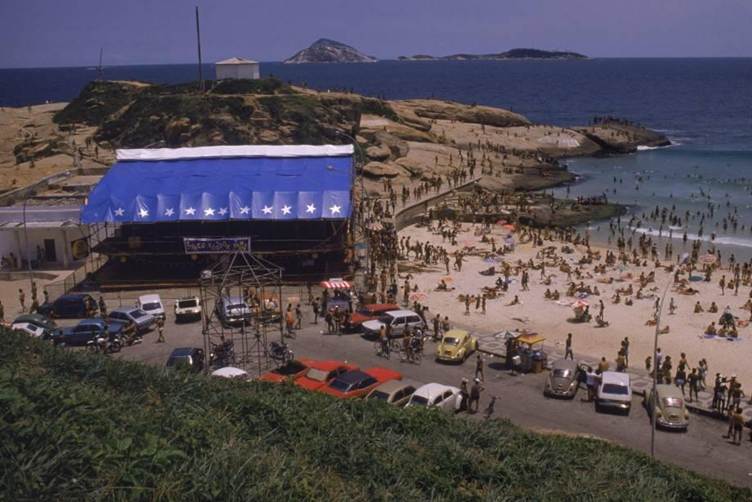
Circo Voador, in 1982. By Ricardo Chaves, Abril Cultural
Preservation of the Arpoador is largely due to the work of volunteers. One individual in particular stands out: For the past two decades, Joel Rodrigues, a parking attendant who worked nearby, has devoted himself to restoring the vegetation in the area. Noticing the growing number of people frequenting the rock—those who go there to clap for the sunset, as well as those practicing sports—was causing serious damage to the vegetation. For over ten years, Joel worked alone replanting the vegetation that had practically disappeared from the Pedra do Arpoador. Since 2015 he has had the help of journalist Fernanda Cubiaco. There are now a hundred volunteers working on the project and they have introduced about 20 species of vegetation. These actions contribute to the local biodiversity and help prevent coastal erosion.
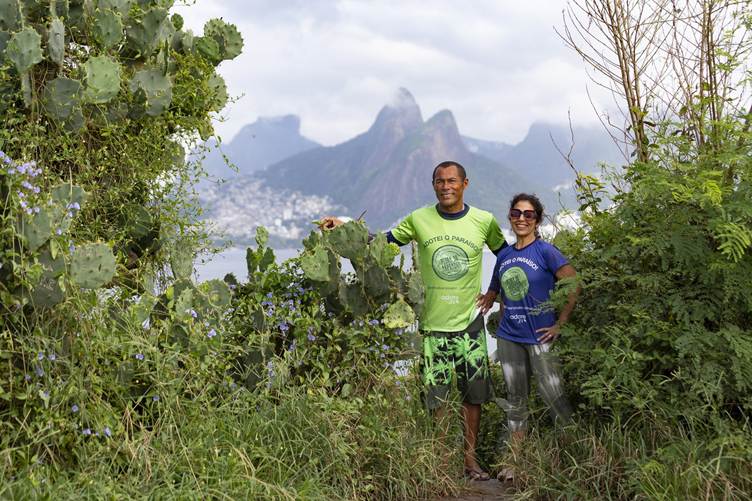
Joel Rodrigues and Fernanda Cubiaco. Photo: Roberto Moreyra / Agência O Globo
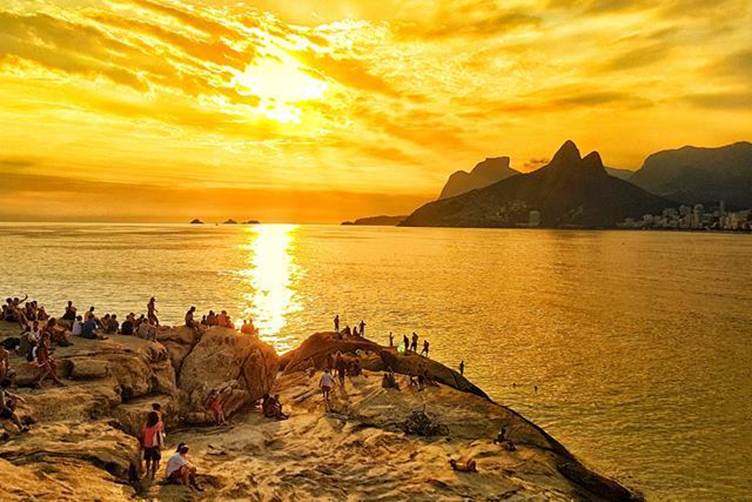
The sunset seen from the Arpoador, with Morro Dois Irmãos and Pedra da Gávea in the background, is worthy of applause and local residents and tourists do so every day. This tradition is said to have begun sometime in the 1960s. Journalist Carlos Leonam—a trendsetting columnist in the city—was one of the principal people to start the practice of applauding the spectacle created by the setting sun. In 1974, an advertisement for the swimwear brand Rhodianyl helped to make this a popular habit throughout Brazil, but the trend actually began in the Arpoador.
And indeed, the beauty of this carioca heritage echoes in the verses of Carlos Drummond de Andrade:
“The sun took its leave with dignity. Streaks of pearly silver softened the green of the water. Neutral, the blur of houses. Mountains grew as light as a bird, then disappeared. I felt the sway, the breath, the consolidation of this moment unlike any other, as it broke free of time, as did I.
Such is the Arpoador.”
Reproduction