

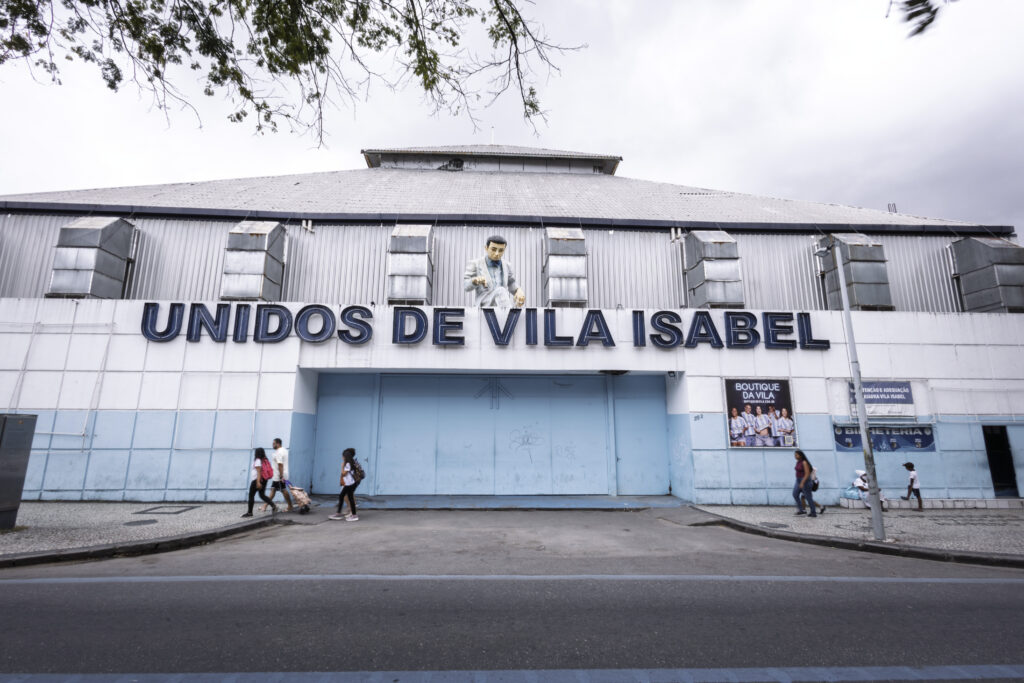
Unidos de Vila Isabel court
This sign is part of the Rota do Samba de Vila Isabel – Os Três Apitos circuit. Click here to access the interactive map with all the locations and discover this and other circuits.
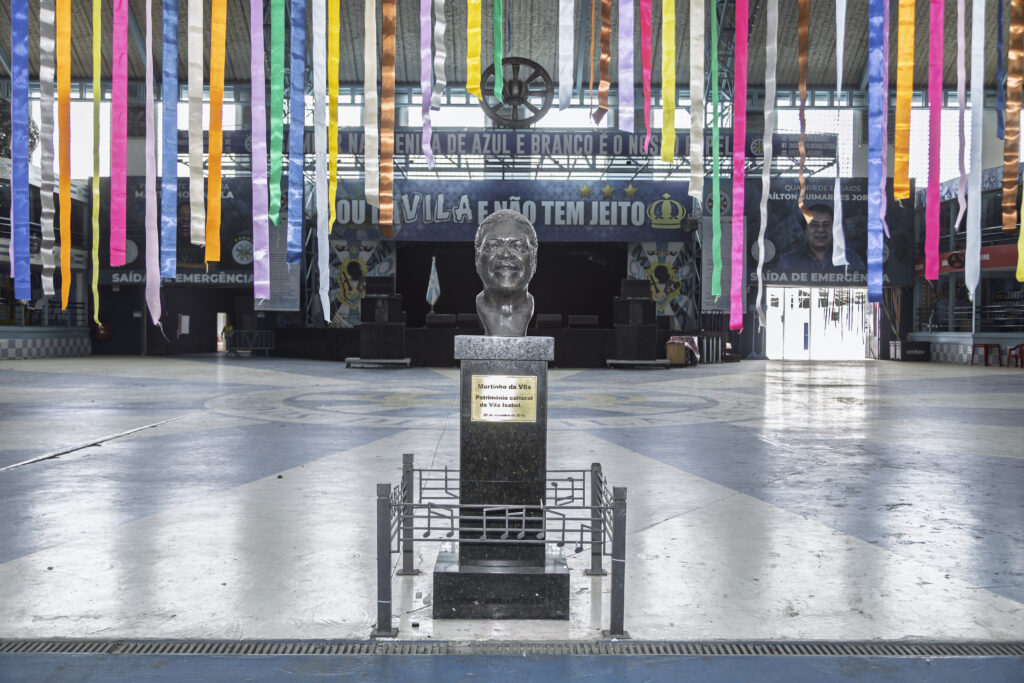
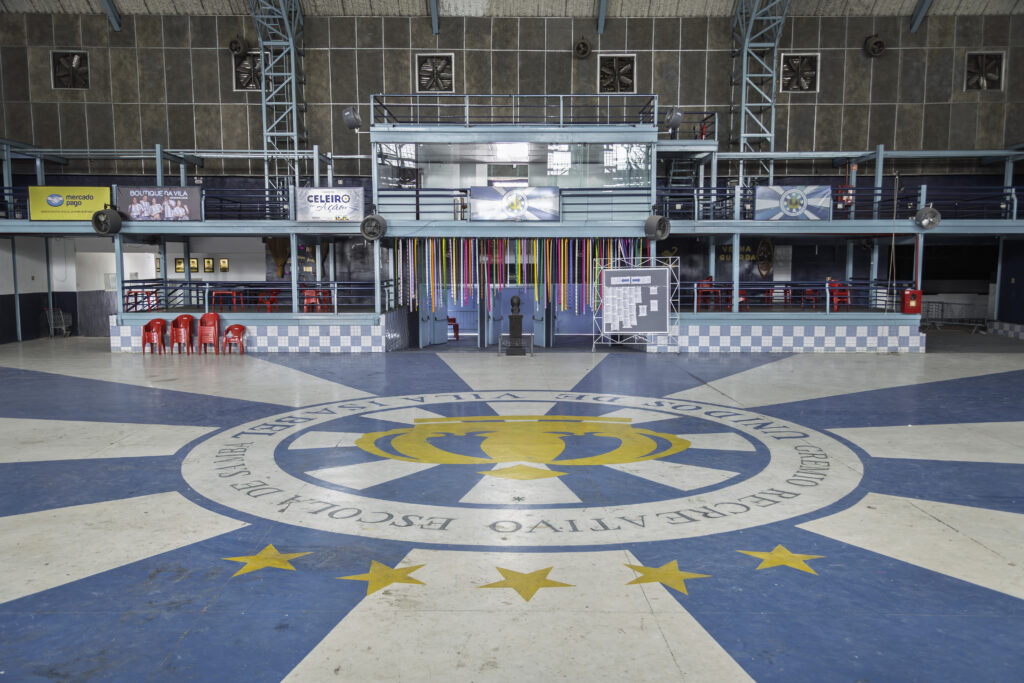
In 2010, the Unidos de Vila Isabel quadra became the largest of all the samba schools in Rio de Janeiro. Spanning approximately 4,000 square meters with a capacity of around 11,000 people, the space was built on the site of the former Public Transport Company (CTC) and Detran offices. Its prominent position on Avenida Boulevard 28 de Setembro symbolizes the neighborhood’s strength and modernization.
The school’s history dates back to 1946, when Seu China (Antônio Fernandes da Silveira), a resident of Morro dos Macacos, founded the Grêmio Recreativo Escola de Samba Unidos de Vila Isabel from the Bloco Azul e Branco. Originally from the Salgueiro community, Seu China initially brought blue and white to the school, colors that would later be adopted by Vila, while Salgueiro adopted red and white. Seu China kept his home as the association’s headquarters until 1958. Since then, the school has moved through several locations until acquiring its permanent headquarters on Boulevard 28 de Setembro. Another founder is Paulo Brazão, who was born in Morro dos Macacos. In 1949, he was honored as Cidadão Samba (Samba Citizen), establishing himself as one of Vila’s greatest composers. He wrote 17 samba songs.
The school’s emblem reflects its identity: the stars represent the titles won; the crown refers to Princess Isabel, after whom the neighborhood is named; and the coat of arms features musical symbols, such as the treble clef, tambourine, and feather. These symbols reinforce Vila Isabel’s connection to poetry and music.The neighborhood’s abolitionist tradition has had a profound impact on the association’s history. In 1988, the centenary year of the abolition of slavery, under the presidency of Lícia Maria Maciel Caniné (Ruça), the school won its first title in the Special Group with the theme “Kizomba, a Festa da Raça” (Kizomba, the Festival of Race), conceived by Martinho da Vila. Despite having few resources, the parade was marked by creativity and the use of simple materials, with strong Black protagonism, and the samba exalted the resistance of Black people. Without a rehearsal space of their own, the school held rehearsals in the streets of the neighborhood, a tradition that remains alive today.
A tradição abolicionista do bairro marca profundamente a trajetória da agremiação. Em 1988, ano do Centenário da Abolição, sob a presidência de Lícia Maria Maciel Caniné, a Ruça, a Unidos de Vila Isabel conquistou seu primeiro título no Grupo Especial, com o enredo “Kizomba, a Festa da Raça”, idealizado por Martinho da Vila. O samba exaltava a resistência do povo negro e, mesmo com poucos recursos, apresentou um desfile marcante pela criatividade, pelo uso de materiais simples e pelo forte protagonismo negro. Sem quadra própria, os ensaios aconteceram nas ruas do bairro, tradição que permanece viva até hoje.
Segundo Diniz (2008), a fundação da Unidos de Vila Isabel esteve mais ligada ao entusiasmo popular do que à presença de grandes nomes consagrados, o que talvez explique a adoção simbólica de Noel Rosa, o Poeta da Vila, como patrono da escola. Essa homenagem se manifesta em espaços como o “Cabaré do Noel” e na bateria “Swingueira de Noel”.
According to Diniz (2008), the founding of Unidos de Vila Isabel was more linked to popular enthusiasm than to the presence of big names. This may explain why the school adopted Noel Rosa, the “Poet of the Village,” as its patron. Tributes to him are evident in spaces such as the “Cabaré do Noel” and the “Swingueira de Noel” percussion section.
Notable figures include Martinho da Vila, a member of the Composers’ Wing since 1965 and the current honorary president. In 2026, the school will parade down the avenue with the theme “Macumbembê, Samborembá: I Dreamed That a Samba Dancer Dreamed of Africa,” in honor of Heitor dos Prazeres. Unidos de Vila Isabel is more than just a samba school. It is the living expression of the neighborhood’s memory, resistance, and cultural identity.