Rio sobre Rochas

CURADORIA

Marcelo Motta de Freitas

REVISÃO

Davi Aroeira

FOTOGRAFIA

Renato Oliveira

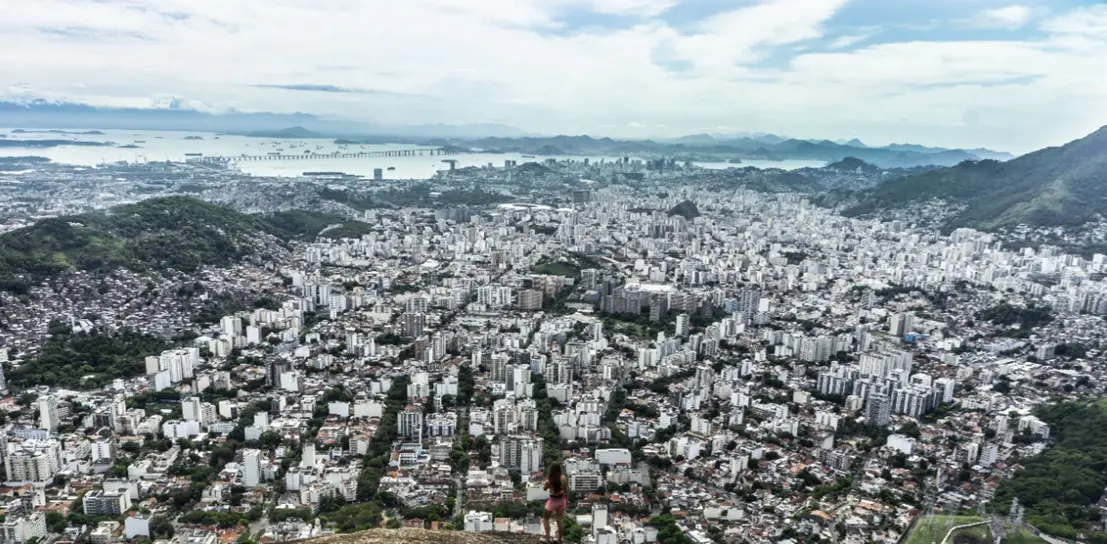
The production of the space we inhabit is the result of various processes accumulated over time in our materiality and social relations. Space is composed of the indissociable set between the occupied area (formed by reliefs, ecosystems, atmospheric dynamics) and the processes of occupation (relative to relations of power, culture, politics, social, and economic): an amalgam that registers, records, and graphs on the ground its unique and exclusive mark, which we commonly call landscape or, more deeply, geography – the graphics on the earth. This landscape is made of visible things and, also, of immaterialities that result from social relations and involve power, economic value, political and cultural interests. Geodiversity, among many definitions, can be understood as the diversity of geological and geomorphological features and processes that interact with culture, modeling the landscape. Rio de Janeiro does not escape this process, expressing very well in its geography the interweaving of buildings over rocky massifs, coastal lowlands, and the different ways of living in such distinct spaces. Each valley carved by a river or each lowland, with beaches and restingas, nestles and accommodates parts of our city and influences our lives. The rocky formations and their dynamics interact intensely with urban daily life, whether with the waterfalls that cool their visitors or the landslides and floods that afflict us in hot and rainy summers. It is not an easy task to inhabit Rio de Janeiro, a city where the relief is not just a scenery — it is the protagonist of the life that pulses between mountains, valleys, beaches, and lowlands. Since its foundation, the city has been configuring itself over this rugged terrain and the influence of these physical dimensions are present, designing the stage of events and shaping its own construction. It is in this unique relief that we inscribe our presence, diverting rivers, filling in marshes, beaches, and mangroves, climbing to the peaks and descending into the subsoil. We were and are forceful in the construction of our own living space. The geological history of Rio de Janeiro dates back to very ancient tectonic movements in continental collisions that forged, in high temperature and pressure, our rocks. Later, the separation of the continents and the opening of the Atlantic Ocean completely altered the relief and raised our sugar loaves, hunched hills, peaks, and serras. Tropical rains, storms, and tempests sought to lash and destroy these formations over the millions of years of evolution of this landscape. Valleys were carved, sediments distributed in low areas, rivers, marshes, and bays formed. Forests and associated ecosystems occupied their habitats with exuberant flora and abundant fauna. Humans recorded their first traces in the Rio de Janeiro and Guanabara region around 8,000 years ago and are associated with the global warming that the planet experienced with the end of the last glaciation. The tropicalization of these environments attracted human hordes who arrived through the Amazon and occupied the hinterland of Guanabara given its abundance of resources: mangroves, marshes, fish, crustaceans, fresh water from various rivers that reached the bay. After these prehistoric peoples came the tupinambás, temiminós, and other indigenous nations who occupied our territory. But this historical account is already in the gallery

Rio before Rio

and here we will deal with the spatial dimension of the facts, thinking about the geography of these processes.
Explore as salas

Praias, costões e ilhas

To inhabit the coast is to live on the edge, on the threshold between land and sea, where the exchange of elements carves, in an arduous and continuous labor, the contours of rocky points, sand ridges, and subaquatic elevations that reveal themselves as islands above the sea line. Life comes in waves, guaranteeing the identity of the marvelous city, whose coastal dynamics deliver a geography that pulses, erodes, renews itself, and gives color to the Carioca skin. Rio de Janeiro is born because of the Atlantic, with its body turned toward the salty horizon. Its existence is coastal, its territoriality maritime: it is a city of inlets, bays, restingas, coastal reefs, and islands that imprint a unique frame, where the Forest is Atlantic and the Mountain is of the sea. It is landscape as a condition of life. The city is adorned with beaches that are not merely postcards, but lived, contested, felt territories. Sand is a space for leisure, but also for work, for inclusion, for exclusion, for dynamic culture. Each beach in the city marks history, records moments, tells events. “From Leme to Pontal,” Copacabana, Ipanema, Barra da Tijuca and Recreio are visible arenas where the spectacle of the urban is displayed with its contradictions. The more hidden ones—Prainha, Grumari, Joatinga—hold silences, resistances, and other forms of being with the sea. Each strip of sand is also a strip of history, marked by diverse human occupations: indigenous people, fishermen, vacationers, tourists, merchants, homeless people. From Mate com Limão to Biscoito Globo, from the tip of Calabouço to Piscinão, Saudades, Leme and shipwrecks are grains of sand within this ocean of complexity that the most beautiful coastal city in the world can contain. At the stone tips that draw the coast's contour, the rocky reefs are geological monuments sculpted over millions of years by tectonic pressures in contact with the incessant impact of the waves. They are ecological transition areas between the terrestrial and the marine, where plant and animal species adapt to the sun and salt in an intense and fragile way. They are also spaces where the human leaves traces: opened trails, graffiti, antennas, viewpoints, vestiges of faith, selfies, and trash. The encounter between the rock and the sea there is not just physical—it is a clash of times, of rhythms, of presences, and of absences. The islands, in turn, tips of land elevations surrounded by tides and waves on all sides, witness from a certain distance the hustle and bustle of cars, pedestrians, bicycles, and scooters of urban daily life. The islands are also, by history, or rather, by geography, geopolitical: military, industrial, militia, and trafficker territories. Some closer and historically used, such as the island of Laje or that of Cobras, are marked by military and symbolic uses. Others are shelters for marine fauna and guard coastal vegetation that has historically resisted and are exceptional refuges for transoceanic migratory routes. Some were tombado by memory, such as the Fiscal island, where the last ball of the Empire took place. Others remain untouched, floating over the city's time. As fragmented pieces of the continent, they are actually protruding tips of the drowning caused by the marine transgression that advanced over our coast. They are integral parts of the Carioca landscape, from the Guanabara Bay to the Baía de Sepetiba. The beaches were the target of urbanization, consecrating the use and the sea bath as indispensable to the Carioca's existence. However, the limitless occupation compromised the ecosystems over the restingas, marshes, and mangroves that guaranteed biodiversity, water, and climatic balance. The dynamic erosion of these areas exposes the lack of understanding of the occupation processes that advanced over the buffer zone between continent and sea with their avenues, buildings, and houses. The islands, the reefs, and the beaches already feel the pressure of a time in which extremes are uncomfortable. It is necessary to read this coastline not as a limit, but as a living line that connects mountains and valleys to the ocean. An edge that does not separate, but integrates dynamics, like a skin that exchanges with the external environment. In this case, a skin tanned by the sun, dried by the salt, and impacted by the waves of good weather and “ressacas” of tropical storms. It is where the rocks dissolve into salt, the sand dances with the waves, and where the human can, perhaps, relearn.

enter

Explore as salas

Quer saber mais sobre a história do Rio?