Rio de Monumentos
CURADORIA
Davi Aroeira Kacowicz
It is common to associate the word “monumental” with something magnificent, imposing, and grandiose. This adjective derives from the word “monument,” of Greco-Latin origin, which means to remember, alert, and advise. However, a monument does not need to be stunning to fulfill its primary function, which is to remind the living of an event, an idea, a group of people, or a biography. Its importance resides, above all, in evoking in the public the act of remembering, transforming something or someone into an icon.
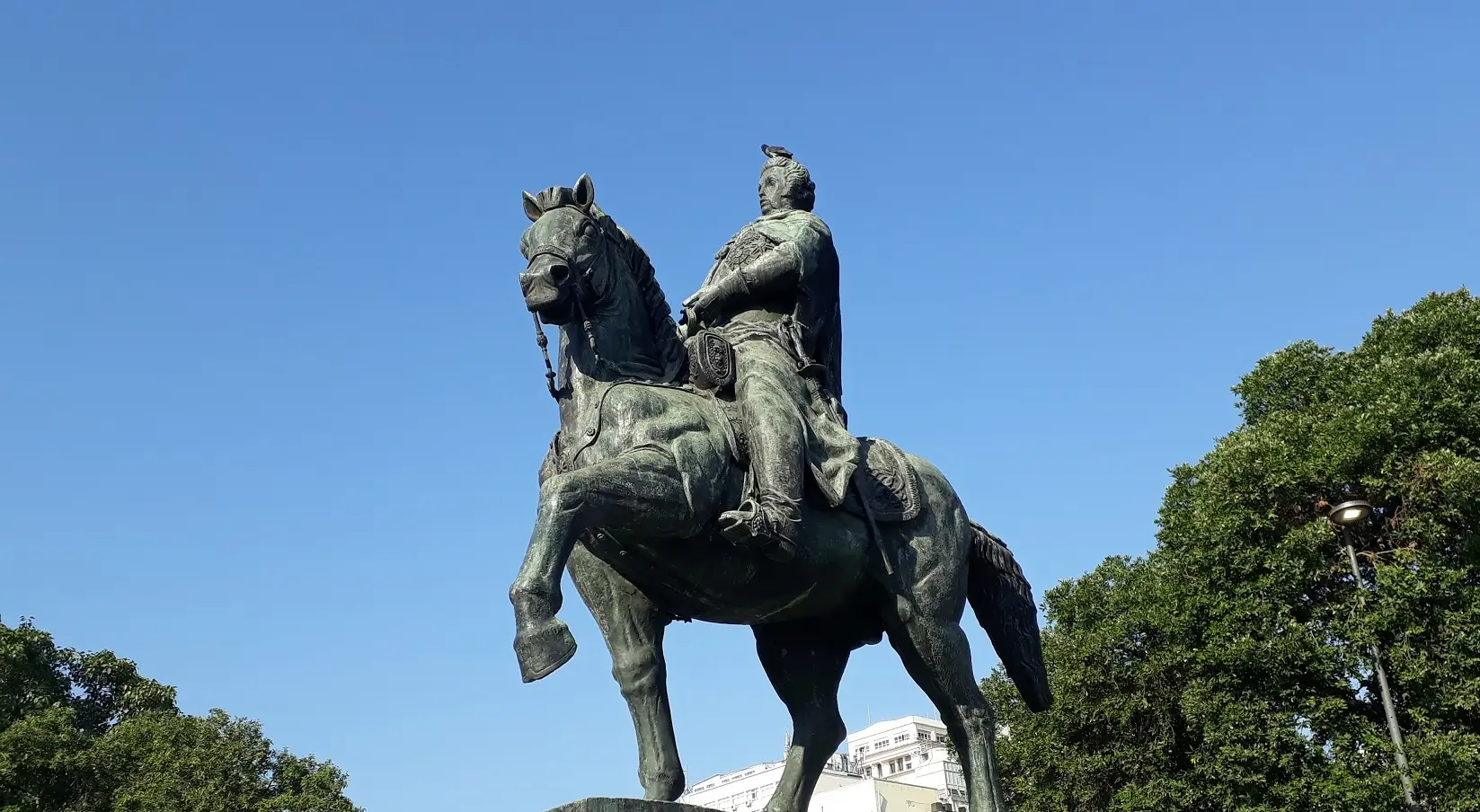
There is no large city in the world that does not have its monuments, whether they be statues, sculptures, monoliths, etc. But in Brazil, no other city possesses as many landmarks of memory as Rio de Janeiro. In the squares, avenues, and other public thoroughfares of the Fluminense capital, there are hundreds of monuments marking ideologies, imaginaries, political projects, and aesthetic sensibilities of diverse moments over the last five centuries. They are pieces of stone and metal coated by layers of history.
And perhaps, precisely because of the large number of these pieces, there is a certain trivialization surrounding them, diminishing the questioning of who the represented person is, who produced it, when and why. It is always good to remember that all memory is a dialogue with the present.
Every past was once a present. For that very reason, the contextualization and knowledge of the history of these monuments is fundamental for their significance and recognition in current times.
Heroes and patriotic symbols are exchanged with the speed of a change in government or regime, and the idols and references of our cultural imaginary are also renewed. Thus, we perceive a set of historical values (religious, political, cultural), represented in a plastic manner. The material, size, arrangement, and allocation of these objects say much about the intentions of those who built them. “Every image tells a story,” said the English historian Peter Burke. Therefore, it would not be absurd to say that from every monument, various stories emanate.